
Biological Station
Biological station
- 2022
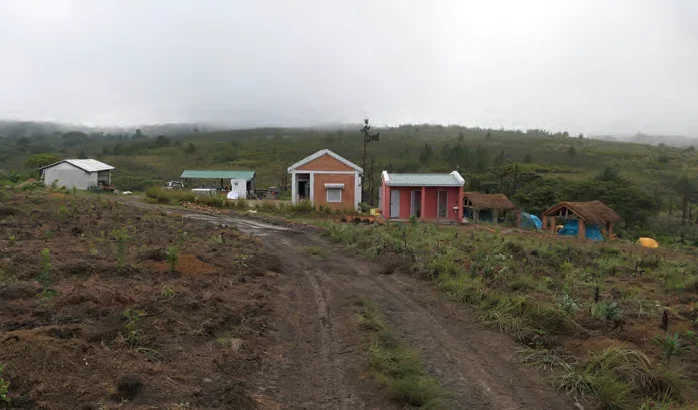
Over the past couple of years, under the guidance of Achille Raselimanana and Jacquis Tahinarivony, a modest and functional field station building was constructed at the site by a team composed primarily of local workers. The station was officially inaugurated on 20 December 2022. This new facility provides significantly improved logistics for scientists working in the protected area, supporting various ongoing Vahatra research projects, the ecological restoration project (detailed below), and the storage of equipment between visits.
The station comprises three main rooms: a kitchen and dining area with a set of bunk beds, a laboratory, and a dormitory with two sets of bunk beds. The facility has a solar installation which provides all of the electrical needs of the station, including water pumping from a lower water source to storage tanks next to the station. The adjacent camping area with lean-to shelters was refurbished in 2024 to accommodate at least 10 tents. Furthermore, a new sanitary block including three toilets and three showers was completed and became operational at the end of this year. To expand the station’s capacity, a 9 x 4 m chalet was installed in 2024, which serves multiple purposes, such as a dining hall, meeting room, or workspace for research and different pedagogic groups. The chalet is equipped with folding tables and about 30 folding chairs, making the space adaptable for various uses and ensuring its practicality for a range of activities. Another key component of Vahatra’s capacity-building program is the promotion of knowledge-sharing and skill development. This occurs not only during field schools but also through the organization of in-situ workshops with civil society organizations. The new chalet is an excellent space to hold different sorts of meetings.
In addition to improving research infrastructure, the station plays a vital role in generating income opportunities for local communities. This includes purchasing local food products and employing individuals as cooks, forest guides, porters, helpers, camp managers, field assistants, and for data monitoring. These economic incentives encourage local engagement in forest conservation efforts, which is essential for the long-term preservation of the remaining forests in collaboration with local communities and Madagascar National Parks.
Moreover, it is evident, at least in Madagascar, that the presence of biological stations, along with students and researchers, deters illicit activities in surrounding forests. In the coming year, additional infrastructure upgrades and modifications will be implemented to further enhance the station’s functionality and provide better facilities for visiting researchers.
Because Madagascar has been an island for tens of millions of years, many of the plants and animals that live there are found nowhere else.