
Developing Effective Rodent …
Developing effective rodent control strategies to reduce disease risk in ecologically and culturally diverse rural landscapes
- 2021
This project, named REDROZ (Reduce Rodent Zoonosis), aims at reducing the risk of rodent-borne infections in Africa, including Madagascar, by increasing knowledge and expertise needed to develop holistic rodent management applicable for local conditions and at the community level. Research is designed to answer whether sustainable community-based rodent management can reduce risks of disease transmission and improve overall human health and wellbeing. Multidisciplinary activities conducted in Tanzania and Madagascar, focus on three rodent-borne infections (leptospirosis, plague, and rickettsiosis) and proceed in two different stages. First, we fill-in knowledge gaps, and deepening our collaborations with communities and stakeholders, allowing us to co-develop rodent control that are holistically evaluated in the second stage. We are developing a spatially realistic modelling tool to explore likely responses of rodent populations and rodent-borne infections to localized rodent control. Analyses of rich archived datasets and new experimental trials are being used to parameterize models and test output.
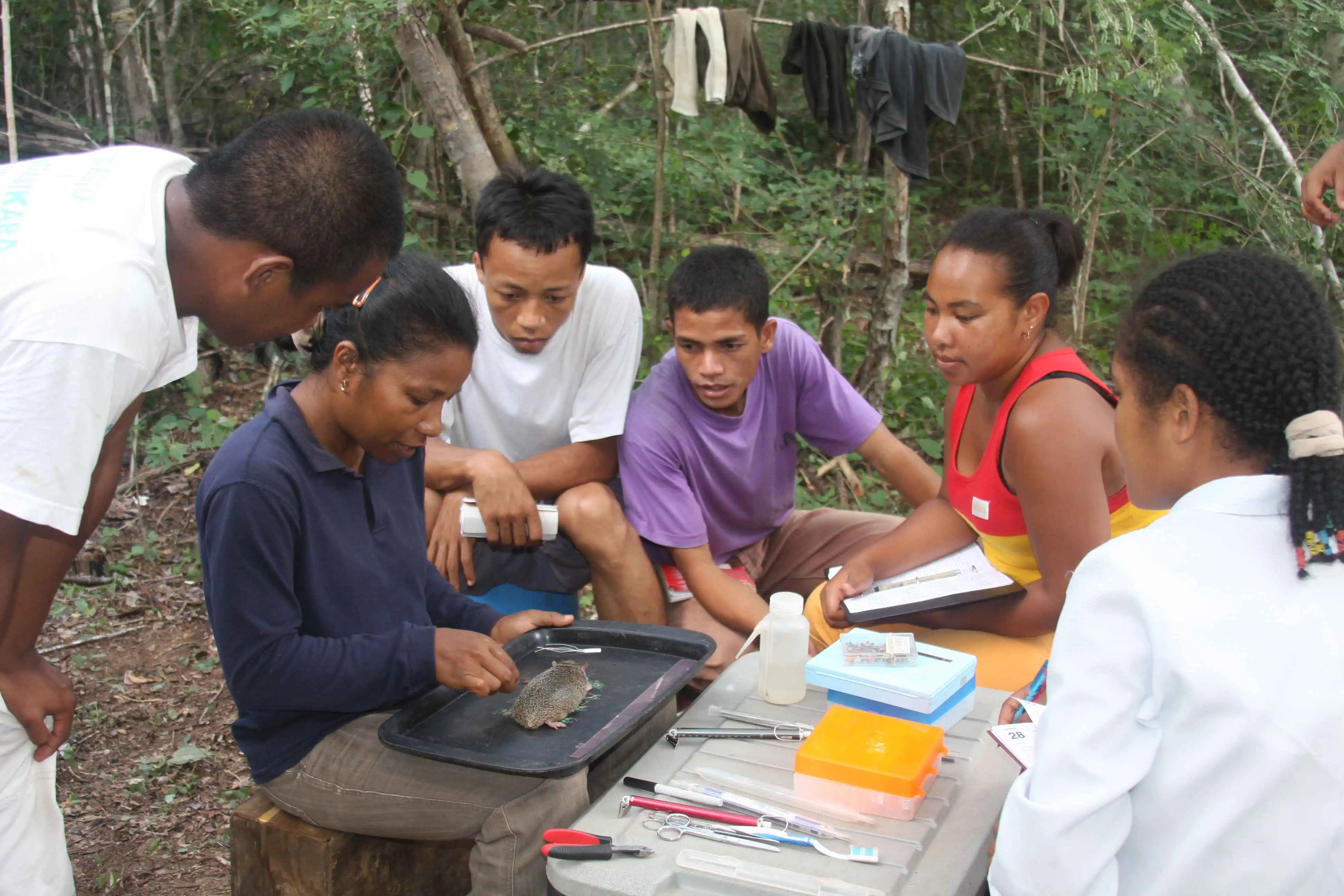
In Madagascar, the study is in collaboration with Institut Pasteur de Madagascar (IPM) and Association Vahatra. In early 2023, a meeting was held at IPM with numerous national and international researchers under the theme “developing effective rodent control measures for introduced rodents”. In the first stage, the project focuses on work in 12 villages within Analavory/Miarinarivo commune (Central Highlands to the west of Antananarivo), where villages act as replicates, experimentally determining how rodent movements and the prevalence of rodent-borne infections are impacted by control. We use a range of qualitative and quantitative social science techniques to produce a deeper understanding of community practices, behavior, and understanding around relevant issues of health, hygiene, and pest management, and work with stakeholders from health, agriculture, and environment spheres to understand their perceptions, policies, and support services. In the second stage, we are conducting a comparative trial in 12 intervention - non-intervention village pairs (n=24), co-developing and trialing rodent management strategies over one year, and monitoring changes to human practices and attitudes, rodent damage, disease within the rodent population (i.e. leptospirosis, plague, and rickettsiosis), human health indicators and time/financial inputs. Collaborative workshops are designed to facilitate cross-country comparisons and exchanges between the Ph.D. students from Madagascar and Tanzania. A student from The University of Antananarivo, Todisoa Radovimiandrinifarany, is integrated in the project in the context of his Ph.D. research, and three students from The University of Fianarantsoa have taken part in the fieldwork in the context of capacity building.
Collaborators
- Global Challenges Research Fund (GCRF)
- United Kingdom Research and Innovation (UKRI)
Because Madagascar has been an island for tens of millions of years, many of the plants and animals that live there are found nowhere else.