
Field Schools In …
Field Schools in the Mantadia National Park
- 2024
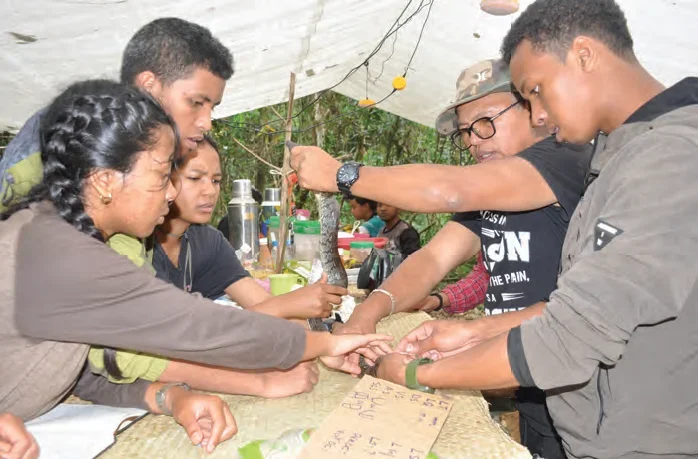
During 2024, Association Vahatra held two different field schools in the Mantadia National Park, about a four-hour drive from Antananarivo, and at a forest camp site. During the first outing in March (rainy season), six Master’s and PhD students from Mention Zoologie et Biodiversité Animale, two individuals each from local conservation organizations including Mad Dog Initiative and Ecovision, two people working for Madagascar National Parks, and five locals coming from surrounding communities. During second outing in October (dry season), nine Master’s and one PhD students from Mention Zoologie et Biodiversité Animale, two individuals from Madagascar National Parks, and four local people took part. Also, for the Master’s students that joined the second trip, they had largely completed their coursework and close to deciding the subject for their research memoirs. During the two field schools, the participants were divided in several rotating groups, presented by different specialists, including those on plants (with an emphasis on measuring aspects of vegetation structure and species diversity), reptiles and amphibians, birds, small mammals, and bats; for the different animal groups there was a focus on aspects of ecology, capture, manipulation, identification, and zoonotic disease research.
Field school activities included a standard inventory of two different forested zones, within the national park, one in a relatively undisturbed section and the other in a mixture of heavily disturbed and regenerating forest. The two areas are contiguous and provide a setting to understand the possible dynamics of forest animals adapting to different levels of human disturbance. Hence, we were able to simultaneously use the field schools to conduct a research project, and these aspects were part of the experience for the students.
This style of field school serves several different important functions. Firstly, introducing the students to real hands-on activities outside of a largely theoretical classroom context, and allowing them to understand different aspects of conducting field research for a variety of organisms. This constitutes a major step for their graduate studies by helping them to decide on the subject and group they will focus on. Secondly, on the side of Vahatra, field schools act as an important filtering process for the young Master’s students to be invited to conduct their studies under the direction of a Vahatra scientist. After spending some extended time with a group of students in a field school setting, based on their level of interest, curiosity, and intellectual capacity, it is evident which are the best candidates to receive the mentorship of Vahatra scientists.
After the field school in October, the eight mid-term Master’s students were asked to pick a subject and research topic for their memoirs and to write a research proposition, including a detailed budget. With the help of a Vahatra scientist these proposals were notably edited and refined. Thanks to several generous donations, we were able to raise the needed funds to cover the Master’s research of a good proportion of these students. The submitted proposals have been evaluated and scored by the four Vahatra vertebrate scientists and the results of who will obtain subvention funds will be made known in early 2025.
Because Madagascar has been an island for tens of millions of years, many of the plants and animals that live there are found nowhere else.