
E-Book On The …
E-book on the protected areas of madagascar and other user tools
- 2015
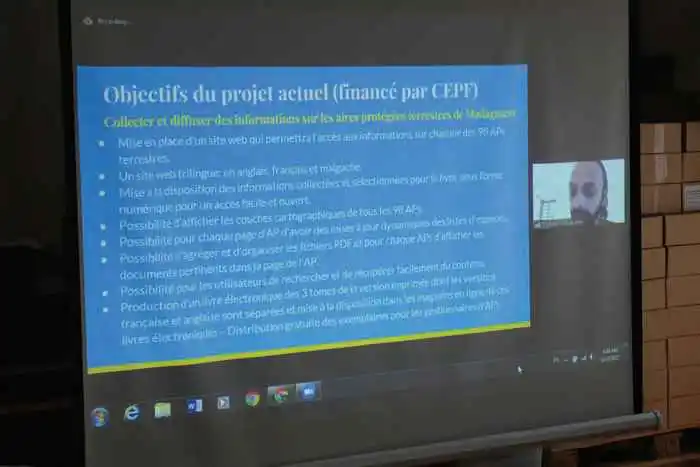
In late 2015, Association Vahatra received a three-year grant from CEPF to conduct a large-scale review of the protected areas system of Madagascar. The bilingual French-English three volume book entitled Les aires protégées terrestres de Madagascar : leur histoire, description et biote / Terrestrial protected areas of Madagascar: Their history, description and biota was published by Association Vahatra in late 2018. Based on an additional grant from CEPF to Strand Life Science (Bangalore, India), with Association Vahatra as a partner, an e-book of a revised and corrected version of the protected area book has been produced, and is distributed by The University of Chicago Press (https://w.bibliovault.org/BV.titles.epl?pc=596&sort=title). The printed volumes of the protected area book are cumbersome to say the least, weighing close to 7 kg, and the e-book version greatly facilitates their utilization. Further, to simplify usage and be more user-friendly, separate e-books have been prepared for the French and English language versions. Other aspects of this project included the creation of a website in Malagasy, French, and English containing lots of details on the 98 terrestrial protected areas of Madagascar covered in the book, including up-to-date species lists of vertebrates known from each site, as well as the means for citizen scientists and naturalists to update the downloadable species lists based on new observations and published data. Based on a day-seminar presentation in Antananarivo by Thomas Vattakaven and Prabhakar Rajagopal of Strand Life Science and different members of Association Vahatra to potential users of the site, important input was received on aspects that facilitated the website organization. The timing of the seminar was just before the start of the COVID-19 epidemic and all subsequent work on the project has been via email and video conferences. Another important aspect of this project was uploading on to a cloud and providing free access to about 9000 pdf files used in writing the book, which include a range of different types of publications, unpublished reports, previously unavailable DEA and Master’s memoires, Ph.D. theses, and other types of diploma documents from the Malagasy university system. The Madagascar Protected Areas portal site can be accessed at https://protectedareas.mg/. The portal is an important tool for researchers, students, and conservationists on Madagascar and overseas and we hope to amend the project to more advanced stages. In early December 2021, our colleagues at Strand Life Sciences in Bangalore via a video conference formally presented the portal in Madagascar to an assortment of interested individuals physically present at Vahatra or connected via a video conference, which was followed by a reception. The event received press and television coverage. The final accepted report to CEPF was submitted in late 2021 and the first phase of the project has now been completed.
Collaborators
- Critical Ecosystem Partnership Fund (CEPF)
Because Madagascar has been an island for tens of millions of years, many of the plants and animals that live there are found nowhere else.